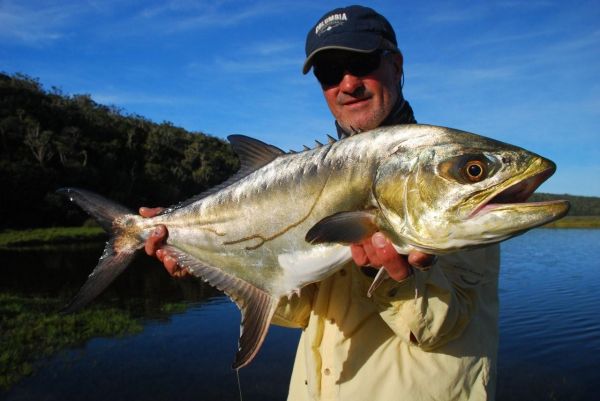
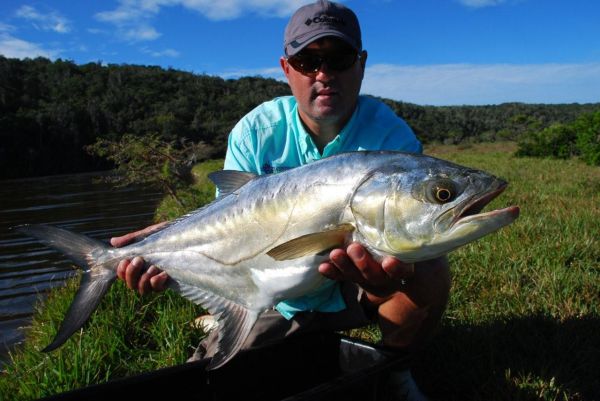
Last year, on a trip to the Eastern Cape, we spent a couple of days at Kleinemonde, near Port Alfred. There we fished the West Kleinemonde river, which is closed to the sea, and has been for the last five years. The kob and Garrick trapped in this blind river have grown to adult size, but are unable to leave the system until they get enough rain to open the mouth of the river.
We fished all day, from before sunrise to after sunset. Most action around the first and last hours of daylight, particularly the kob. Garrick were around at any time, but also more aggressive in the low light periods.
We had great fun catching these awesome fish on light tackle , working lures through the channels and along the banks. It was quite different fishing a blind estuary, as there is no current and no tidal influence. We found that this being the case, we could use lures that give lots of action when worked slowly. The number one lure without doubt in this situation was the Rapala Glidin’ Rap. It suspends and sinks, very slowly when not being twitched, but had a beautiful side to side twitching action when being worked. It was absolutely deadly for kob in particular, though the garrick also loved it.
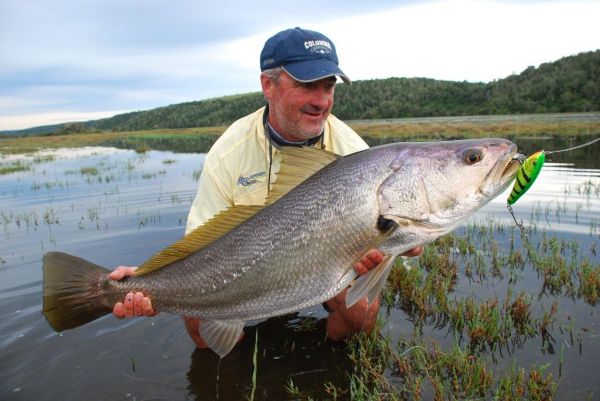
We had an absolute ball catching good sized fish in the river. It was quite challenging, as the fish in blind rivers seem to be a touch wiser, and perhaps less aggressive than those in open estuaries, but then the challenge makes it all the more rewarding. Also, there is the fact that you know the fish have to be there, they could not have gone out to sea, and there is nowhere else for them to go.Something else interesting that happened while fishing for the kob and garrick in the West Kleinemonde river; Chris was throwing the cast net about a hundred metres along the bank, looking for some mullet to put out a livebait while we were spinning. He shouted that there was a kob smashing the mullet after he had thrown the net and chased the mullet out into deeper water. This happened a couple of times, with the kob lurking in the channel and hitting the mullet just after the net had landed, sometimes the whole head and most of the body of the kob was coming out of the water. Paul went up to where Chris was throwing his net and flicked his Glidin Rap into the channel and almost instantly went vas with a 15kg kob. Normally you would think that throwing the net would chase the bigger fish away, but in this case it obviously attracted the kob, which came to investigate what all the splashing was about.
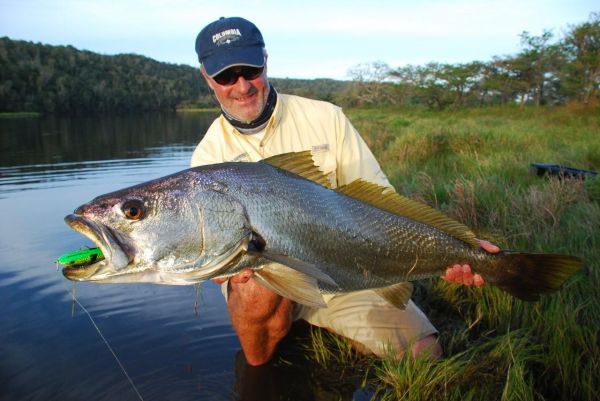
What a lot of people do not realise is that these fish do not breed in the estuary itself. They spawn out at sea and the young larval stage fish enter the river during an open phase. They then live in the estuary until they reach breeding size in some species, or in the case of white steenbras, they move out to sea once they are large enough to deal with the conditions in the surf. If they remain trapped in the system they can never breed, as all breeding is done in the marine environment. For this reason a blind river will have bigger and bigger fish in it evey year that it remains closed, with no small fish. Even the mullet get bigger, and you can no longer find small mullet. The predators also start to feed on other species of fish such as cape stumpnose and mozambique tilapia. The tilapia breed in the estuary, so there will always be small ones around. This is what the cormorants etc are feeding on in these blind rivers that have been closed for some years.Interestingly there are also other organisms that rely on being able to access the sea in order to breed such as mud prawn. Mud prawn cannot continue to exist in a blind estuary that remains closed for too long, as they need a marine phase in their breeding cycle. Sand prawn are a different story and can breed within the river system. For this reason many of the blind rivers have a population of sand prawn, but not mud prawn.
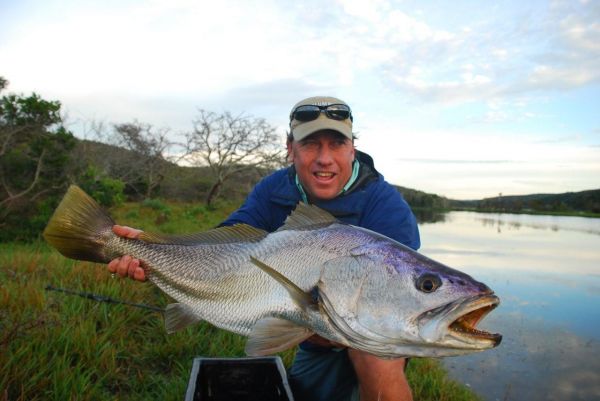
Once again in a closed system like this it is critical to release your catch, as there is no way for those fish to be replaced, and if you want to continue enjoying that fishing in that system you need to look after the stocks of fish in it!
Latest posts by Craig Thomassen
(see all)
Related