


With the rising popularity of vertical jigging in its various forms a number of anglers are coming into contact with species of fish that they may not previously have encountered. This style of fishing does bring in a great variety of fish, including a number of predatory bottom fish species which would seldom, if ever be caught using other methods of fishing where the same depths are not reached by the lure or bait.
Identifying these fish can be tricky, especially as the bulk of our catches these days are being released, and one has to rely on memory or a photograph to try and identify the fish after the trip. If the fish can be placed in a family group, then it makes identification a lot easier. For example it narrows down the search a lot if you know that you are looking for a snapper species, than if you are just paging through a fish book hoping to find a picture of the fish that you caught.
One of the groups of fish that are being regularly caught jigging are the jobs and jobfish, which are part of the snapper family (Lutjanidae). These fish are caught more often jigging than by any other form of fishing. Some of them are caught at greater depths than others, but most are caught near the bottom or in the mid water where they occur.
There appears to be a certain amount of confusion surrounding the identifying of this group of fish, so hopefully this article will clear up some of the misunderstanding. There are five species belonging to the group which occur in our waters, three of which are true jobfishes, while the other two are smalltooth jobs.
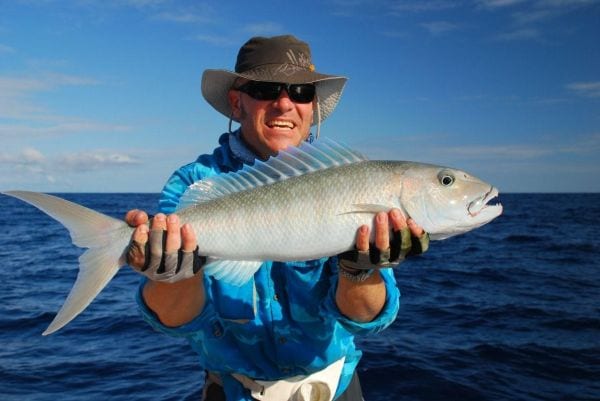
Below: A green Jobfish showing its normal colouration.
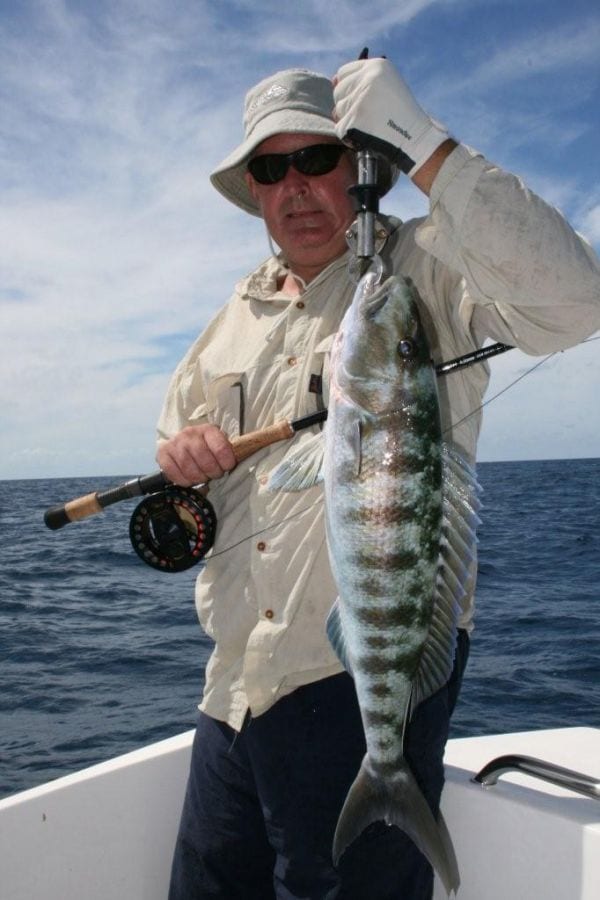
Below: A green jobfish, lit up and excited, showing a mottled colouration.
Green Jobfish Aprion virescens
The most commonly caught of the jobfishes is the green jobfish, also known as a kakaap. This species is probably the most widespread of the group, and is an aggressive predator which hangs around reef structure at a depth of anywhere from 15m to around 80m. It preys on other fish, crustaceans and squid and will even come to the surface at times and hit a surface lure. Green jobfish have been amongst the species allowed to be caught within the iSimangaliso wetland park, where only gamefish are allowed to be taken. This has led to some confusion, as anglers assume that this species is a game fish. It is in fact not a game fish at all, and is a member of the snapper family. The green jobfish is also the easiest of the group to identify. It is generally a pale green colour, but at times can be mottled with darker blotches and bands.
Green Jobfish are often caught on bucktail jigs or dropshot, whipped up off the bottom with a quick jigging action. They are most often encountered over sand patches on reefs, or along reef edges, rather than over the reef itself. They hit a lure hard and fight determinedly, often boring down hard towards the bottom. This species can usually be comfortably caught on light to medium jigging tackle. This species grows to around 13kg’s.
Below: A red smalltooth job.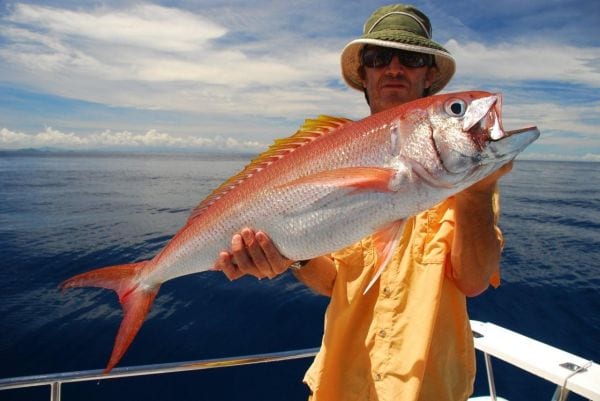
Red Smalltooth Job Aphareus rutilans
Another fairly widespread member of this group, also known as a rusty jobfish by some. The red smalltooth job is frequently misidentified as a rosy jobfish. This species is silvery with a pink or reddish tinge and some yellow on the dorsal fin. It has a large mouth, the gape of which extends to in line with the back of the eye. The inside of the mouth is shiny silver. It is found in deeper water than the green jobfish, usually from 40m to 100m. For this reason it is usually caught on heavier jigging tackle and metal knife jigs. It is a strong fighter that will give the angler a hard time for the first part of the fight, but often becomes bloated with barotrauma as it gets pulled up and then cannot fight near the surface. Red smalltooth jobs grow to around 12kg’s.
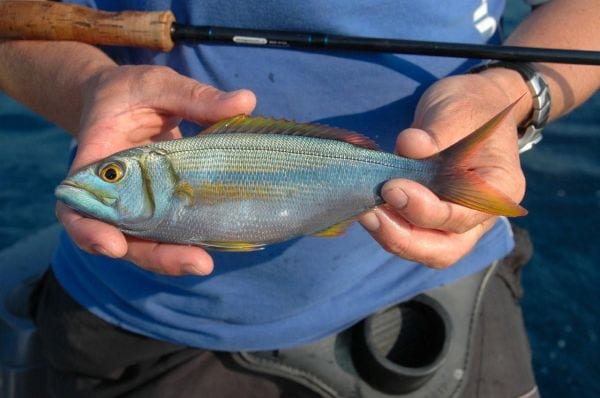
Below: a blue smalltooth job
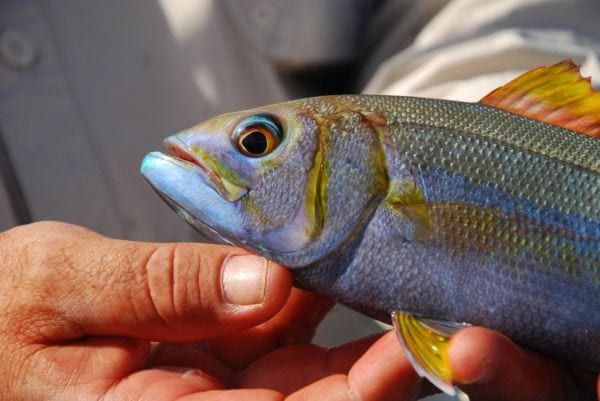
Blue Smalltooth Job Aphareus furca
A fairly unusual species to catch, blue smalltooth jobs are normally caught in tropical areas, found as far south as Sodwana Bay. This is the smallest of the jobs, and grows to a maximum of 70cm. The body colour is an electric blue, purple colour, with yellow fins and a golden eye. These fish take small jigs, buctails and dropshots fished up from the bottom in water anywhere from 1m to 120m deep. It is a midwater predator in its habitat and feeds on small fish, crustaceans and squid.
Below: Striped Jobfish
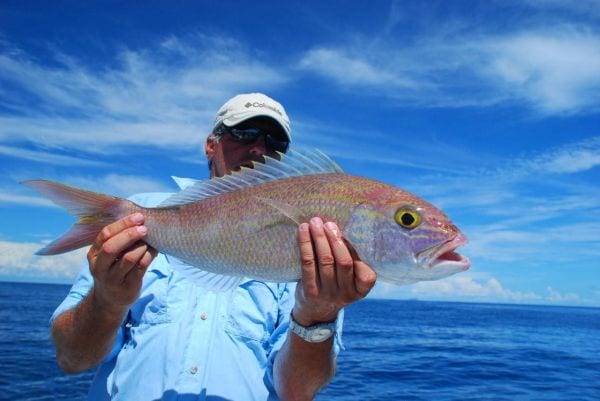
Striped Jobfish Pristipomoides multidens
A deep dwelling jobfish, found at depths of 60m to at least 180m, striped jobfish are also known as goldbanded jobfish. This species is a fairly aggressive fish, which forms aggregations above bottom structure in deep water. It will hit large knife jigs, worked at these depths targeting species such as amberjack and dogtooth tuna. Striped jobfish feed on small fish, crustaceans and squid. It reaches a length of about 90cm, though the common size caught is between 30cm and 60cm. The body colour is pink, with gold diffuse lines and blue dots running along the flanks. It has two golden lines, bordered with blue below the eye. The fins are clear, with a yellow tinge on the edges of the dorsal fin. This species is usually caught on heavy tackle while targeting bigger fish, so does not get the opportunity to put up much of a fight.
Below: Rosy Jobfish
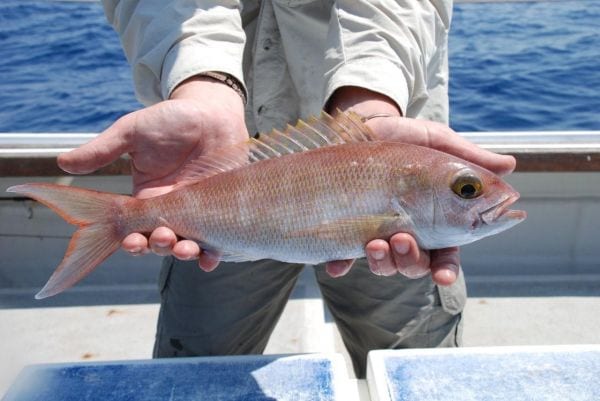
Rosy Jobfish Pristimoides filamentosus
A deep dwelling member of the jobfish family, found at depths of 40m to 400m. Rosy jobfish are generally caught at the limits of jigging depths, from around 150m and deeper. This species grows to a length of 100cm and reaches a weight of about 8kg’s. The commonly caught size is seldom more than 50cm. As with other jobfish species, it feeds on small fish, crustaceans and squids. The body is a pinkish colour with some tiny blue speckles on the back. Rosy jobfish have clear fins, with some yellow tinge on the edge of the dorsal and sometimes some red at the trailing edge of the caudal fin. This species will hit large knife jigs fished deep and seldom gets the opportunity to put up much of a fight, as it is normally caught on heavy tackle at great depths.
- Maldives Trigger - April 28, 2022
- Matoya Humpback – Figuring it out - December 15, 2021
- Mixing It Up - November 24, 2021