


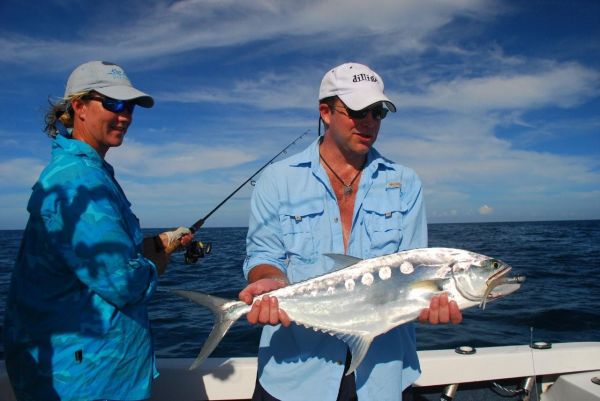
Of all the gamefish species that we catch regularly in the Indian Ocean, one species that is custom designed for light tackle lure fishing is the Queenfish. With its willingness to attack artificial lures, its hard fighting abilities, spectacular aerial jumps and the fact that it is a clean fighter preferring to keep the fight in open water rather than head for the reef it is perfect for light tackle lure angling.
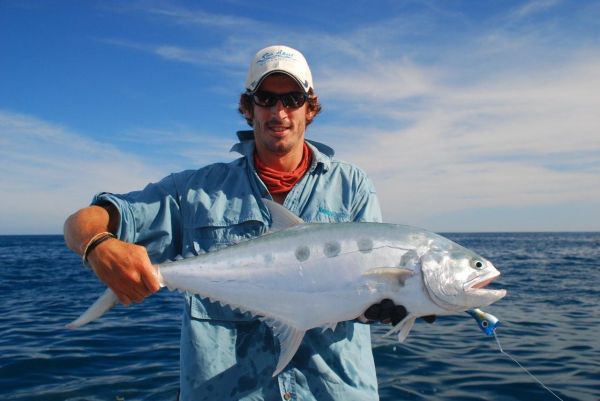
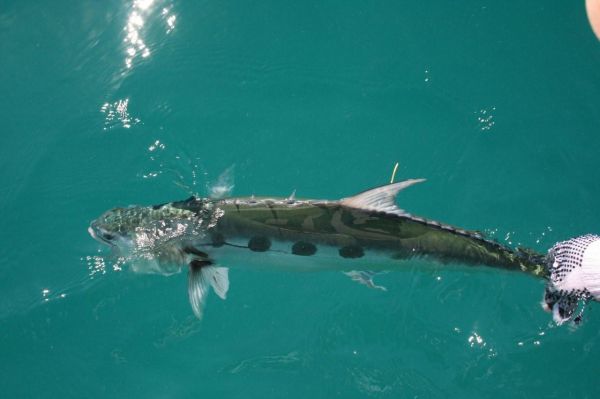
Above is a beautiful largemouth queenfish caught on a Williamson Jet Popper in Mozambique.
These exceptional fish are found in warmer waters, from the KZN south coast northwards along the East coast of Africa. There are three species of Queenfish in our waters, the largest of which is the Largemouth Queenfish Scomberoides commersonnianus. This species prefers warmer water, from 21 to 30 degrees Celsius and is generally found offshore in relatively shallow coastal waters. They frequent reefs and sandbanks with deep channels nearby with an average depth of between twelve and twenty five metres. They do make forays into the surf zone and into estuaries, particularly over high tide periods.
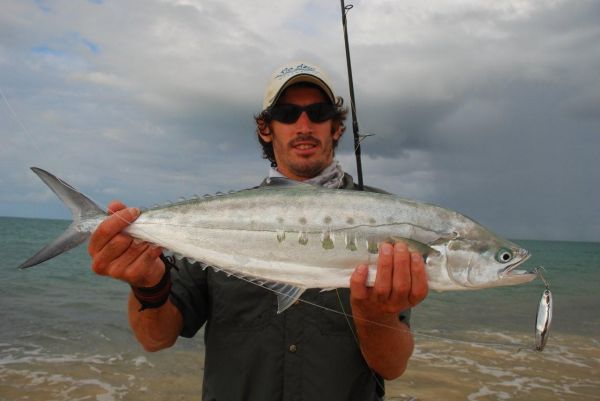
A double spotted needle scale queenfish caught on spoon from the beach.
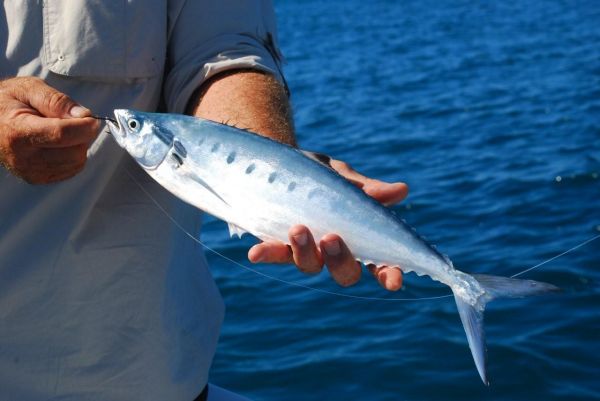
Needlescale queenfish are common in warm water along the east coast of Africa, they bite willingly, but don’t grow very large.
Queenfish are caught more frequently during the summer months when the water is warmer, and generally go off the bite when water temperatures drop below 23 degrees Celsius. Although Queenfish grow to in excess of 15kilograms the commonly caught sizes range between 4 and 8 kilo’s.
Queenfish do enter estuaries and harbours and can be caught in both Durban harbour and Richard’s bay harbour. They are quite fussy about entering estuaries and seem to prefer those with deep water channels at the mouth and plenty of baitfish, which is obviously why they enter the estuary in the first place. In Australia they catch a lot of Queenfish in the big mangrove estuaries in the Northern territories, and although they are caught at times in mangrove lined Mozambican estuaries this is not so common here.
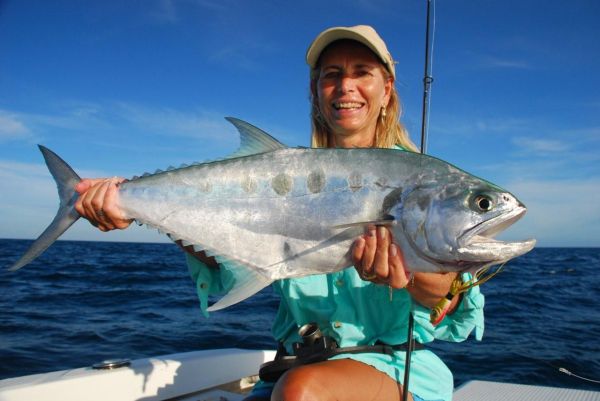
They are more commonly found on, or around relatively shallow reefs offshore, especially if the reef is reasonably close to an estuary mouth. Usually areas that produce species such as yellow spotted kingfish and golden kingfish are also good for queenfish. Queenfish like big underwater sand banks that have baitfish over them. Often a big sand bank with a small patch of reef on it is a good spot, especially if it has fairly strong currents that flow over it and a deep channel somewhere nearby. In this sort of area the Queenfish are concentrated fairly close to the reef structure, but can be caught all over the bank on a long drift, especially around sunset. During the last hour of light they tend to roam in aggressive shoals in the area around the reefs and feed extremely aggressively. They seem to be fairly resident, at least seasonally, and if a queenfish is caught once at a spot, then it is likely that more fish will be caught regularly at that spot.
Queenfish are a shoaling species, though shoals can vary from as few as two or three fish they can also get up to over a hundred fish. They are largely crepuscular feeders, mainly active at dawn and dusk. Though they do come into the surf, these fish don’t come into the surf zone regularly enough to target them specifically, so most fish in the surf are caught while targeting other species such as Kingfish. Queenfish will move into estuaries, as long as the water is fairly clean at high tide. They seem to favour estuary mouth areas and reefs just offshore of an estuary mouth. Large Queenfish will also accompany whale sharks, swimming close by for protection and can be caught by casting a lure close to a passing whaleshark.
HOW TO CATCH QUEENFISH:
From the surf
Queenfish taken from the surf are mostly caught on surface poppers or spoons while targeting other gamefish. They tend to move into casting range from the beach or from rocky points in the late evenings or very early mornings, usually when this coincides with a high tide. They will attack a popper viciously, in a similar manner to Garrick, often missing a couple of times before connecting with the lure. Spoons retrieved with a medium retrieve will normally do the trick for Queenfish in the surf. Dropshots and bucktail jigs worked quickly through the mid-water are also effective. Queenfish are one of the few salt water gamefish which regularly jump clear of the water when hooked. This makes them exciting fish to catch and they give a good account of themselves, especially on light tackle. They are clean fighters, so big Queenfish can quite easily be caught on light spinning tackle.
I have caught a number of Queenfish on light tackle from sandbanks in Mozambique, where the deep channels are easily accessible because there is not much surf to push one far back from the edge.
OFFSHORE:
Most Queenfish caught on spinning tackle are caught from boats. The best way to do this is to locate reefs where this species is regularly encountered. They are quite territorial and will have reefs which they definitely prefer. The boat should be stopped at least a hundred metres upcurrent of the reef and allowed to drift down onto the reef while spinning with surface poppers and leadhead jigs. Surface lures and tend to be most effective around the low light conditions of dawn and dusk. Queenfish love a moving target and will be turned on to strike at fast retrieved poppers, rather than those with a slower blooping movement. Jigs fished deep are often eaten by Queenfish throughout the day. Queenfish definitely seem to prefer jigs dressed with white, yellow or chartreuse being whipped up vertically from the bottom. Queenfish can be quite fussy and leader shy when conditions are marginal, it is a good idea to go fairly light on the leader when targeting this species specifically. No wire is needed for Queenfish, as they do not have cutting teeth. A leader that is too light can, however, be abraded by their small, rough teeth during a long fight, so fluorocarbon is a good option. The shoals seem to have a close bond, and when one fish is hooked the others will often stay around the fighting fish, right up to the point where it is boated. When one person is fighting a Queenfish there is a very good chance of another angler hooking one by casting a lure into the area where the hooked fish is fighting.
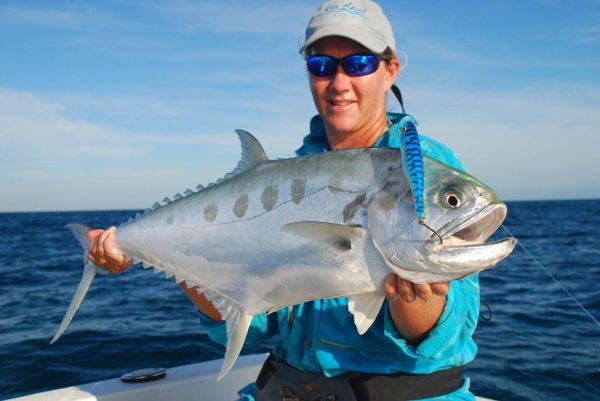
The most effective way of targeting these fish is to drift over the area on a boat, motors switched off and the steering locked so that the motors are turned to face into the wind. This gives you a straight drift that will be the same each time, taking you back over the action. Be sure to start the drift well up-current of the target area and continue well beyond the structure as queenies can be quite far from the actual structure and hunting over open sandbanks in the area. Queenfish will eagerly take jigs worked up vertically from the bottom, pretty much all day, though it often goes quiet during the midday period, or on the slack current on the turn of the tides. I have found that bucktail jigs of around one ounce seem to be very effective. Bucktail jigs should be worked up fast from the bottom with a quick, regular whipping action. The bucktail jigs are fished standard when fishing in a strong current, or when the wind is strong and the boat is drifting fast. This helps them to sink faster, as there is less resistance in the water. When the current is slow and there is less wind then it can be a good idea to dress the bucktail with a soft bait, such as a 5 inch grubtail or fluke rigged onto the hook inside the bucktail.
Plain soft plastics mounted on jig heads (dropshots)are also very effective. Minnow or fluke style softbaits mounted on a jig head of around a half to three quarter ounce are good, especially the white, yellow or chartreuse colours.
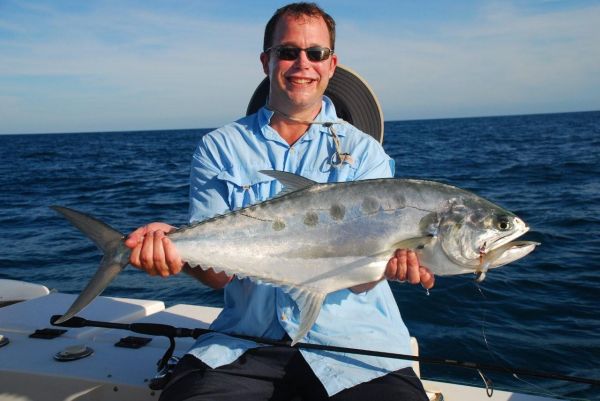
For me the most exciting way of catching Queenfish is on the surface. These fish become very aggressive in the late afternoon and will smash poppers with serious aggression at this time. From around 4 p.m. onwards, when the sun is getting a bit lower and beginning to lay a path of light down on the water, one can expect the queenies to come on to surface lures. The best poppers for Queenfish are 10 to 15cm in length and around 2 ounce in weight. On different days different surface lures work better, breadboard style chisel plugs are excellent, as are chuggers such as Rapala Skitter pops and Williamson Jet poppers. Poppers seem to work very well when there is some wind ruffling the water surface. On calm days when the water is mirror smooth, then I find that stickbaits such as the big Rapala X-Rap Walk does very well when fished with a quick zig-zagging “walk the dog”, type action or even pulled fast through the water with the rod tip held high, so that it snakes and splashes and dives erratically.
Poppers should be fished fairly fast, sometimes with quick, controlled jerks, giving it a good splash, but not letting it leap from the water and tumble over itself. The Queenfish will come onto it, often in packs and slash at it in a frenzy. Often one can see the fish following by swirls behind the lure for a while before they actually hit it. Sometimes they have a few spectacular smashes at the lure before actually connecting. It is important to keep the lure moving with the same action, if not an even more frenzied action once a fish is locked on. Beware of fishing the popper too fast and making it jump out of the water too much, this will generate a lot of interest, but also a lot of missed strikes. It is tempting to strike when you see the water explode around your lure, but doing so can just pull the popper away from the fish if it has missed, which it often does. If you keep the lure moving the fish will usually keep trying to eat it right up to the boat, only strike once the line is tight and the rod is actually bending. Many Queenfish are hooked as the popper is being lifted from the water for the next cast, I have had them jump from the water and take the popper in the air next to the boat!
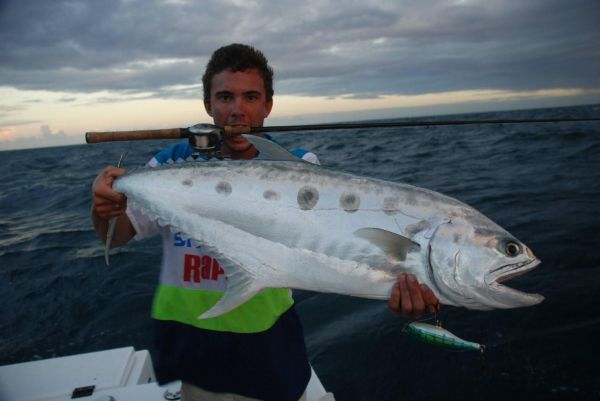
Queenfish are very hard fighters, using their big forked tails to generate serious bursts of speed. They also turn their wide body side on and use the current to their advantage. They often leap spectacularly from the water, shaking their heads to try and rid themselves of the hook. They are clean fighters, not trying to cut the line on a reef as kingfish often do. For this reason they can be targeted with light tackle and provide excellent sport.
Shoals of queenfish will sometimes ball up a shoal of baitfish and chase them onto the surface, where they will slash into them in a feeding frenzy, much like a shoal of kawakawa or queen mackerel will do. When this happens they can be seen from far off because of the birds congregating above them and diving into the water to catch wounded or jumping baitfish. In this situation it is best to cast a surface popper or small spoon into the action and crank it back fast, get ready for explosive strikes on the lure! If the fish ignore your lure it is generally an idea to go smaller, as they can become locked on to the baitfish that they are feeding on and you will need to imitate their size to get the queenies interest.

Queenfish are easily exploited, as they can be caught in large numbers once a productive area has been located. It is not unusual to land ten fish or more on an outing when they are on the bite. For this reason it is very important to look after the fish, revive them properly before releasing them and the fishing will continue to be good for years to come on your spot.
Replacing the treble hooks on poppers and using barbless single hooks in their place is very successful, as the treble hooks do a lot of damage to the fish
TACKLE:
It is important to use good quality tackle when targeting big fish on light tackle, as there is no margin for error and the inferior quality tackle simply cannot take the punch of the hard fights put up by salt water gamefish. The spinning rigs that I find ideal for Queenfish are a quality six to seven foot spinning rod, such as a Shimano Beastmaster Special Tiger or Shimano Trevala 6’6” MH. Good reels for this are Shimano Sustains or Stradics in the 5000 size. These should be loaded with 30lb to 50lb Power Pro braid with a 50lb Sufix Zippy leader joined with a back to back uni-knot, three turns on the leader side and seven on the braid.
- Maldives Trigger - April 28, 2022
- Matoya Humpback – Figuring it out - December 15, 2021
- Mixing It Up - November 24, 2021