


My favourite species of fish to target on light tackle in estuaries, using artificials has to be the River Snapper. I have the utmost respect for this fish, he is without doubt the most challenging of our estuary species in Southern Africa, and worthy of the respect given to him by anglers around the country. I thought I would write a bit of a tribute to this species, including some of my thoughts on catching them, some facts about them and throw in some pics of these magnificent fish that I have got in my picture library. Their scientific name is Lutjanus argentimaculatus But these fish go by a number of common names. Rock salmon, River roman and Nkulunkulu are some of the names that River snapper go by here in South Africa. Nkulunkulu is actualy the same name that the Zulus and Xhosa use for God, so this shows the respect that these people have for this species! In Australia they are called Mangrove Jacks.
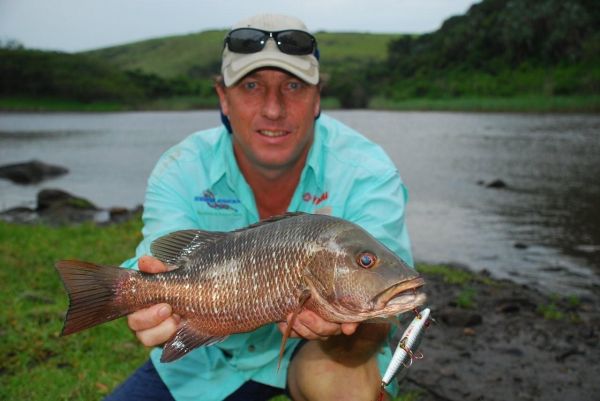
Above is a picture of a typical river snapper caught on a surface lure in a Transkei estuary. In this case the lure was a mirrOlure 7m. River snapper have to be one of the wiliest fish in any salt water river system, they are notoriously difficult to catch at times, as they will stubbornly refuse any offerings when they are not in the mood to eat. I once made at least 50 casts to a piece of structure, knowing that a river snapper must be hiding beneath it. I tried just about every lure in my box, yet there was no sign of the snapper. A small kingfish then hit one of my lures and I started pulling him in, suddenly there was a massive boil on the water’s surface and a flash of deep copper as the stubborn snapper finally came out of his lair and had a go at the struggling kingie. He had been there all that time, watching my lures and refusing them, but couldn’t resist the temptation of the little kingfish!
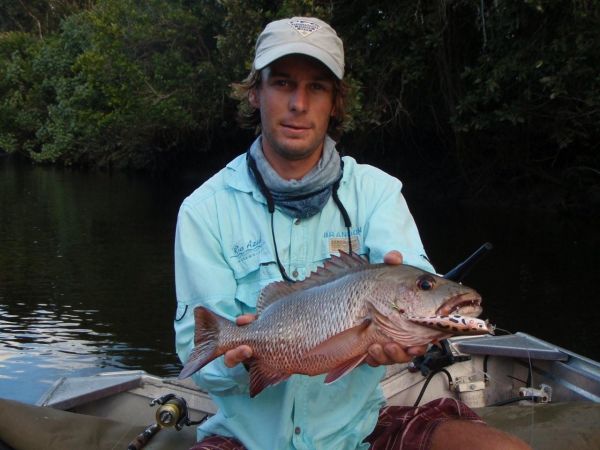
Above is a pic of a friend of mine, Brandon King, with a river snapper taken on the surface on a Rapala Skitter Pop, which he had been working slowly above some submerged timber in a Mozambican estuary. It is for their cunning that River Snapper are well known, as well as for the aggressive smashes that they do make when they decide to eat a lure. They basically turn on the lure and hit it going back to their lair, making a big swirl and hitting extremely hard as they accelerate in the opposite direction. They are extremely dirty fighters, and will cut you off in a flash given half a chance. They live in foul structure, and the fight is often over before it began, with the bemused angler holding a rod with a limp piece of line hanging from it.River Snapper seldom venture far from their chosen structure during daylight hours, preferring to hold up where they feel safe, and will rush out and ambush any passing prey which comes close enough for them to attack without moving too far from the security of their homes. They are predominantly nocturnal feeders, as you can see by the large eye, which is an adaptation for hunting in the dark. This species will roam around the river system at night, often moving right out over sand and hunt for its prey. They like to feed on crabs, shrimp, fish and just about anything else that moves in the water, whether it be on the surface, the midwater or right on the bottom, when they are in feeding mode.
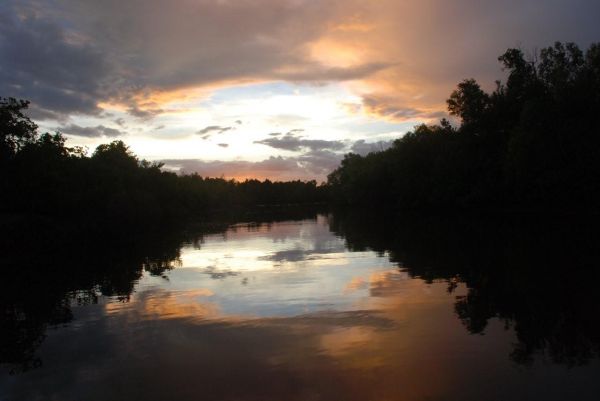
Above: Prime time and prime habitat for targeting River Snapper, after the sun has set these fish become more aggressive and leave cover more readily. River Snapper will use just about any structure as cover, depending on the availability in the river that they inhabit. The more prime the location ( better structure) will generally have the bigger fish, while the smaller fish will be left with whatever cover they can find. These fish are highly residential, and will inhabit the same spot for years. They are not territorial in the strict sense of the word, however, and if the structure can hold multiple fish, then they will live there in groups. A bank of submerged mangrove roots for example may hold hundreds of fish in a fairly small area. They create an underwater maze, which the fish can swim in and out of, giving them complete security and cover. I have snorkelled amongst mangrove roots in a large estuary in Kenya and was amazed at the density of river snapper in a small area, all appearing to live in complete harmony with one another.
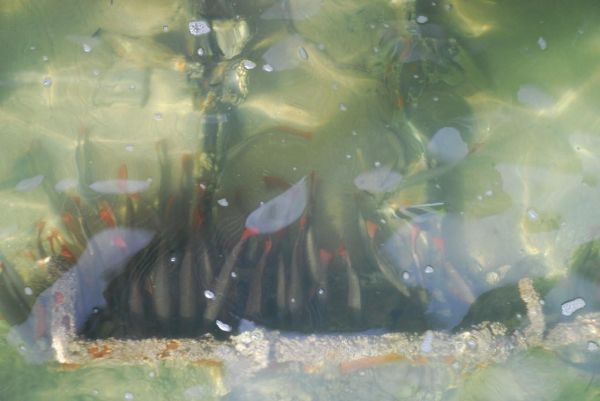
River snapper stacked up behind a piece of structure, giving them a place to sit out of the main current in an estuary. In this case a sunken Land Cruiser in a Mozambican estuary. In estuaries where there are not mangrove roots they will use different structure as cover. Reedbeds are a good place to find river snapper in many of the KZN and Zululand systems. The River Snapper will live along the edges and within the stands of Phragmites reeds, where there are gaps below the water’s surface for them to move in and out of cover. Along rocky banks where trees hang low over the water is a favourite in Transkei estuaries. Below cliffs or ledges, where there is deep dark water is another favourite haunt of this species in the Eastern Cape rivers. Bridge and jetty pilings create good structure for river snapper, particularly if there is a deep hole scoured out where the piling enters the sand on the river bed.These fish are highly adaptable, and can survive in almost any river system. They are tolerant of a wide range of salinities, from totally fresh water, to sea water. I have caught them in the upper reaches of rivers in Mozambique amongst the water lilies in fresh water, more than 40km from the river mouth
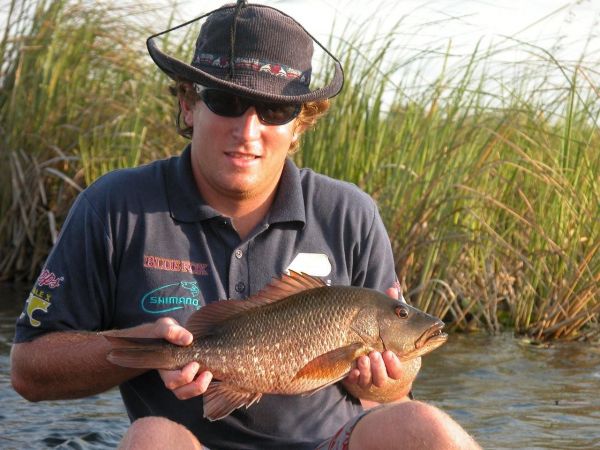
Above is a river snapper caught along the edges of bulrushes at least 30km from the river mouth in totally fresh water in the Govuro river, Mozambique. This adaptability, along with the fish’s natural cunning makes it a real survivor. In mammalian terms I would compare it to a leopard. It is one of the few species of predatory fish that continues to be successful in some of the badly silted up and polluted river systems of the KZN South Coast, for example. It can survive in a river system that is totally cut off from the sea for years, and will exist in places where you would not believe it possible for such a fish to live. This makes it special in my book, and also means that the challenge of catching these wily fish does exist for those of us who have the patience and perseverance to stalk them in the waterways which are ignored by most anglers.
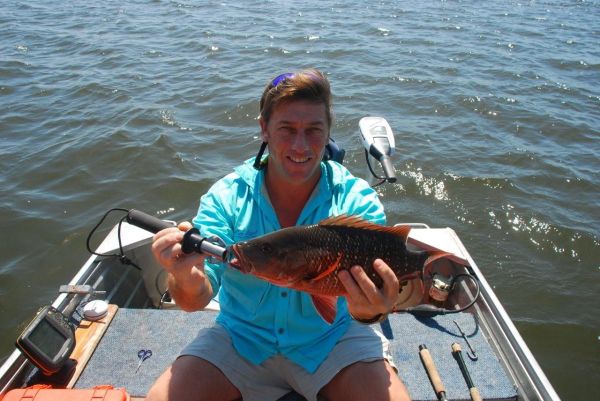
Catching river snapper requires stealth, above all else. In the above pic you will see the electric trolling motor, which makes it possible to sneak up on likely spots and cast to the fish without advertising your presence. These fish can be targeted in a variety of ways, and many will be successful on different days. The traditional way of catching River Snapper in KZN is with live glassies or mullet. I like to fish with artificial lures, however, so I will be talking about fishing for them that way here. Being predominantly nocturnal, most activity will be during the hours of dawn and dusk, when the fish are still in, or getting into feeding mode. Successful snapper fishing means waking up early and being on the water in the dark, and being the last off the water in the evenings. Even better, if you are up to it, is to fish well into the darkness, which is never easy, but can produce great results.
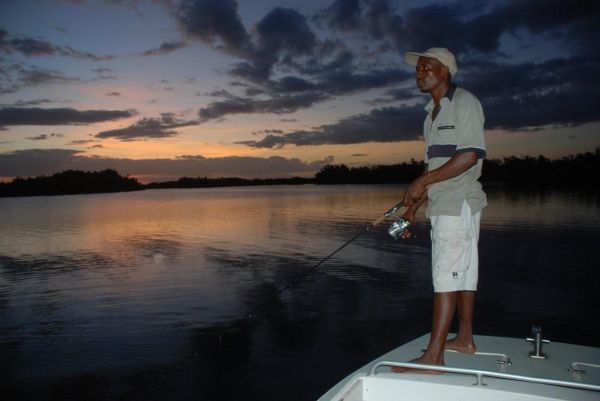
My friend Inacio Simango getting ready to do some battle with snapper in the evening. This a great time to fish for this species, as the water gets calm if the wind drops and allows you to do some nice finesse fishing. One of the most satisfying ways of catching River Snapper is on topwater lures. Almost any lure worked slowly along the surface in the right zone has a good chance of getting eaten at the right time. There are some favourites though, that have worked well for me over the years. Rapala Skitter Pops, Storm Chug Bugs, mirrOlure 7m’s, and Rapala X-Rap Walk lures are amongst my top performers when it comes to catching River Snapper on surface lures.
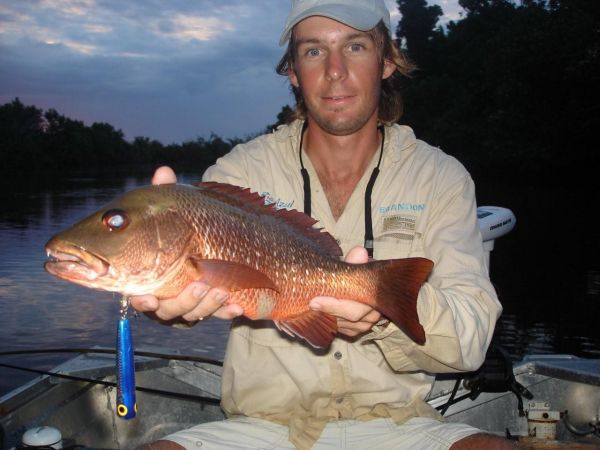
Above is Brandon with a snapper taken on a Storm Rattlin Chug Bug fished along the edges of a mangrove bank in the evening.
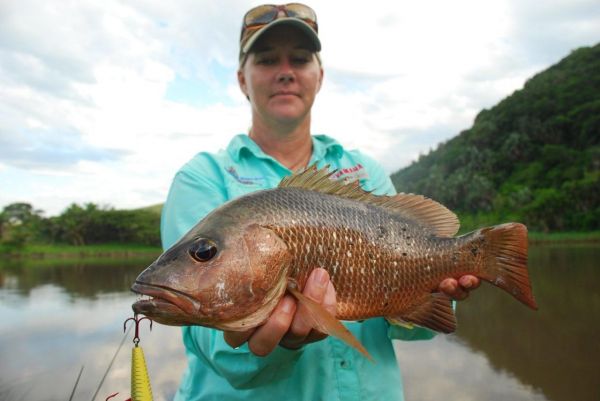
My wife, Pam, with a lovely snapper caught on a surface worked mirrOlure 7m in a Transkei estuary during the late afternoon. Apart from the visual impact of the spectacular smash of a snapper hitting a slowly worked surface lure, it is also a very effective way of targeting these fish for a couple of reasons. Firstly you can get the lure right over the most foul of structure, but it will not hang up, as the lure stays on the surface. Secondly the snapper has to leave the safety of his lair to eat the lure on the surface and you have more time to turn him and get him away from the structure before he cuts you off.
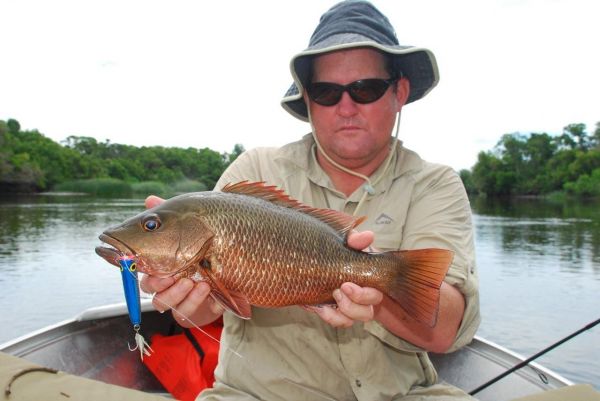
Brett Burnill with a snapper caught on a Storm Rattlin’ Chug Bug in broad daylight.
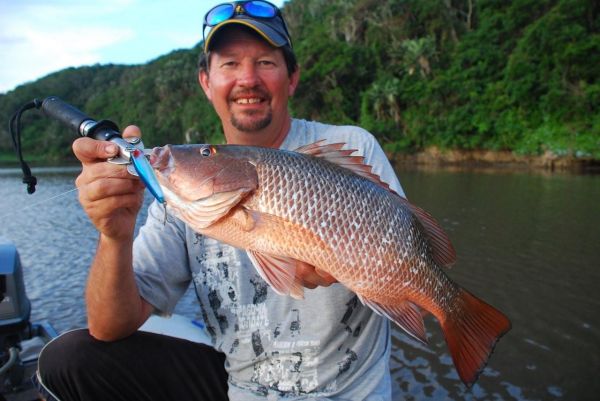
Colin Parker with a lovely late afternoon snapper taken on a mirrOlure 7m in a Transkei estuary. It is crucial to use tackle that can turn a snapper, before he gets back into his structure, but at the same time you want to be able to cast light surface lures. Braid has made this possible. A fairly light rig with a strong drag and 15 to 20lb braid is generally ideal. I like to use a leader of 30lb fluorocarbon, as this material has the best abrasion resistance and is most likely to survive getting scraped against rocks, branches and mangrove roots. Very often the structure is covered in small barnacles, mussels and sun oysters, which will cut through line in an instant when the line is under tension.
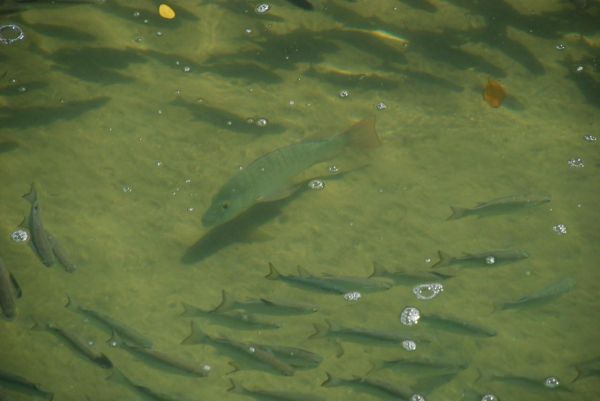
A river snapper swimming amongst a shoal of mullet, the mullet give this fish plenty of respect and a wide berth!
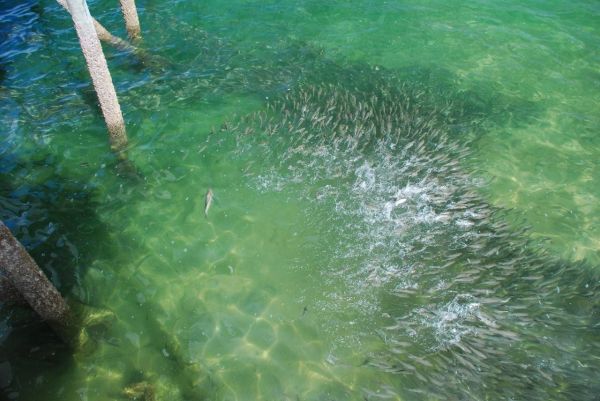
Mullet burst from the water when a river snapper launches an attack. Another successful method of targeting river snapper, is to use diving lures or soft plastics. I have found that soft plastic minnows, Texas rigged, bass style can be very effective. This method has the advantage of being weedless, and you can cast the lure right into the structure. You need to have your wits about you though, for when the snapper hits, you need to strike very hard. This is firstly to set the hook through the plastic of the lure into the fish’s jaw, and secondly to take advantage of the element of surprise and get him away from the structure before he is aware of what is going on.
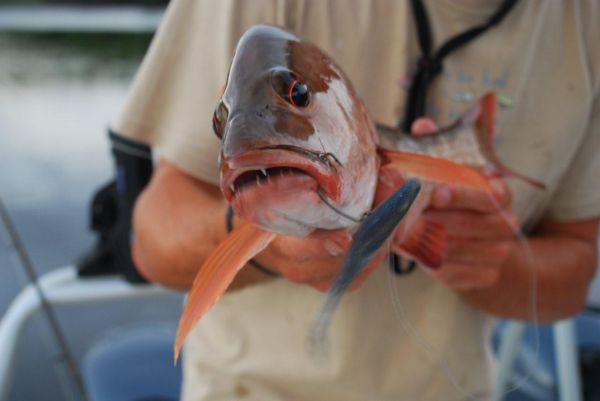
A snapper caught on a soft plastic minnow, rigged weedless on a bass hook.
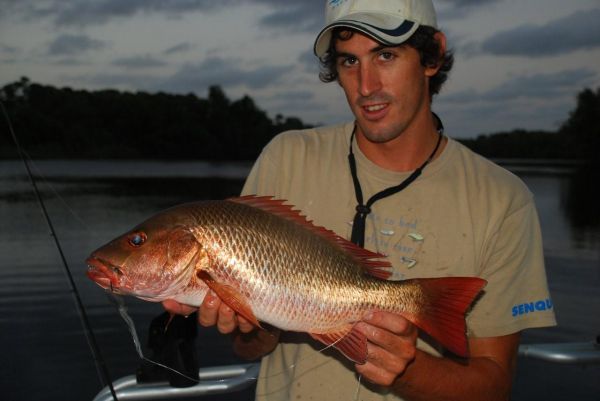
Another view of the same fish.
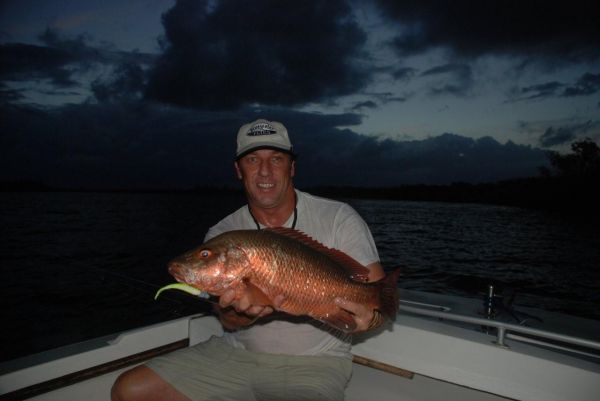
A river snapper caught on a traditionally rigged dropshot during the evening hours. Some of the diving lures by Rapala also work well. I have had great success with Rapala X-Rap lures, twitched around at the edge of the structure, or over it.
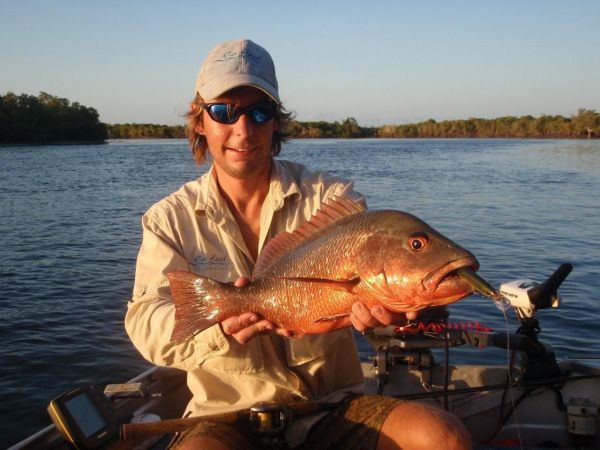
Brandon with a nice snapper taken on a X-Rap fished over an oyster bed.
These amazing fish are found all along the East coast of Africa, from above the equator down to the Eastern Cape. It would appear that Port Elizabeth is pretty much the southern most limit for this species. They live in estuaries during their juvenile stages, using the sheltered water as nursery areas and grow to sizes of around 7kg’s before leaving the estuary and moving out to sea to spend the rest of their lives in the marine environment. They grow to a size of 14kg’s living on offshore reefs.
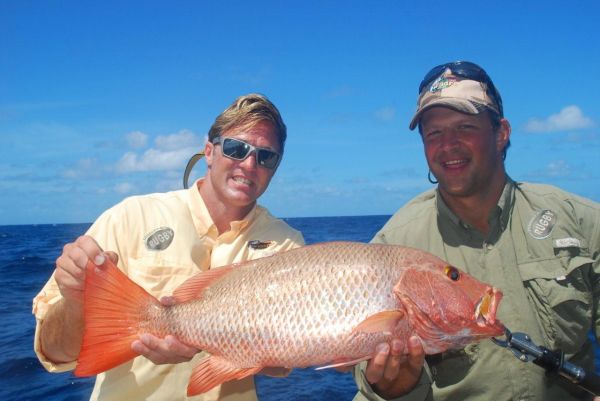
Above is a picture of Percy Montgomery and Bobby Skinstad with a lovely river snapper that Percy caught fishing with a dropshot above an offshore reef in Mozambique. Large adult river snapper can also be found in the surf zone on suitable reefs close to river mouths, such as at Kosi mouth. Anglers spinning for GT’s with large poppers sometimes hook large river snappers when spinning over the ledges at the mouth, particularly when spinning after sunset.Other Zululand reefs along the surfline and shoreline often hold populations of mature river snappers, particularly those that consist of flat ledges that are hollow underneath.The snapper like to live beneath these ledges, seldom venturing out during the day, but coming out at night to roam around and feed.
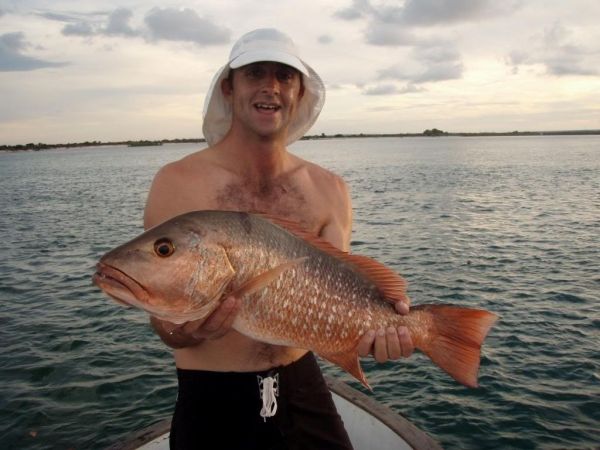
Mark Wals with a real bomber of a river snapper caught on a large popper in an estuary lagoon in Western Madagascar. (photograph courtesy of Mark Wals)
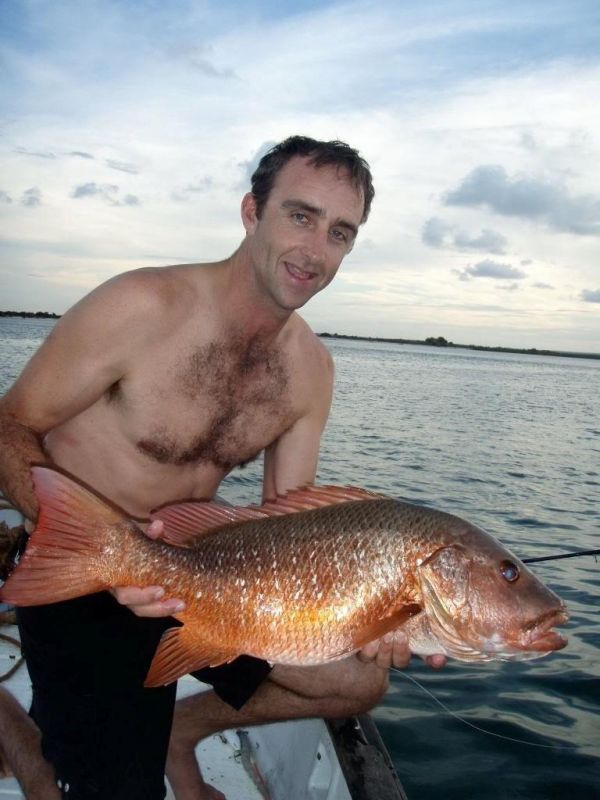
Mark with another beauty of a Madagascan river snapper taken from the same lagoon. (photograph courtesy of Mark Wals) It is during their juvenile to young adult phase, however, when they live in our estuaries and rivers that these fine fighting fish provide opportunity for light tackle lure anglers to target them specifically and test themselves and their tackle to their very limits. Believe me a river snapper over two kilo’s is going to be challenging when close to structure, and a 7kg fish is going to need a lot of skill and some luck thrown in as well to land on light spinning tackle!River snapper occur in pretty much any part of a river system, from the mouth area to the upper reaches and well into totally fresh water if there are no obstructions such as waterfalls blocking their route to get there and if there is suitable structure in that part of the river. These fish are not caught around the river mouth areas that regularly though, during daylight hours anyway. The odd one that is caught close to the river mouths is the exception rather than the rule. The main reason for this is probably because of the volume of water that moves into and out of the estuary mouths with the tides, this causes strong currents, making it difficult to work lures slowly and with the finesse required for targeting river snapper. Also it makes it difficult to get the lure right into the structure and keep it there for any significant amount of time.
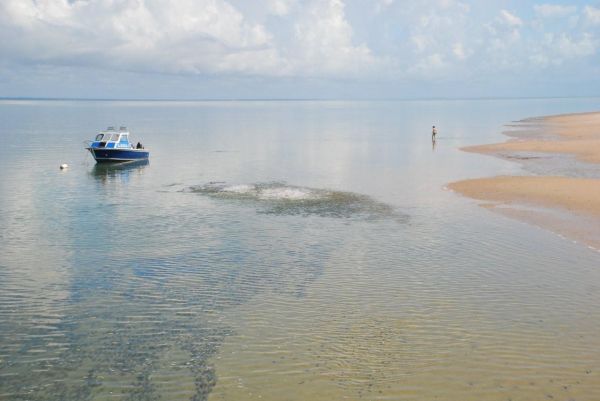
River snapper will use moored boats as structure hide beneath and ambush from when there is a lack of other suitable structure, such as this estuary in Mozambique.
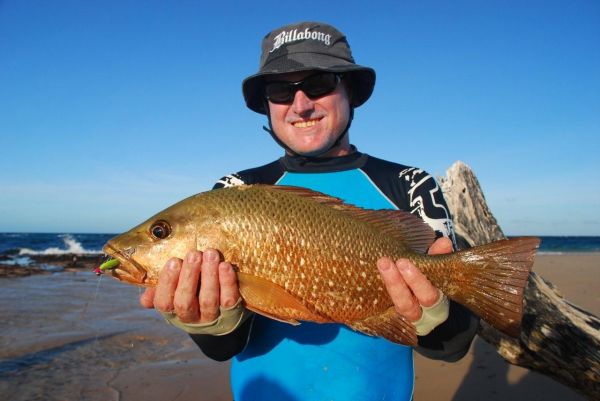
An unusual catch, a river snapper caught on fly at a Mozambican river mouth.
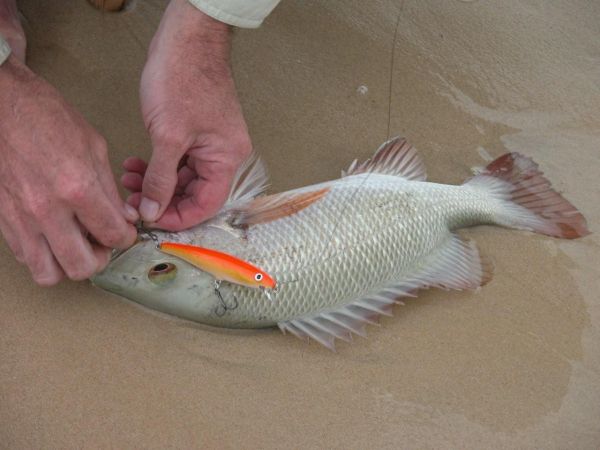
When river snapper are caught in the surf or river mouth area, they are often much paler in colour than those caught further upriver. I have found that river snapper are best targeted in the upper reaches of the estuaries where the current is not so strong. This being said, they do prefer some current to none at all. In tidal rivers, that are open to the sea they will usually be using structure that is either in, or on the edge of the current, where they can lie in ambush and wait for prey items to be carried past them by the water and they can attack with a short rush, without having to move too far from their home.I have found that the outgoing tide is best for targeting river snapper. While they do feed on the high tide, it is difficult to catch them at that time.You can often hear them smashing and gulping small fish, shrimps and crabs deep in the back of submerged mangroves or overhanging trees. When the tide has dropped somewhat the snappers as well as their prey are forced out from the cover into the channels, where they seek cover on the edges, but are more accessible to be cast at.
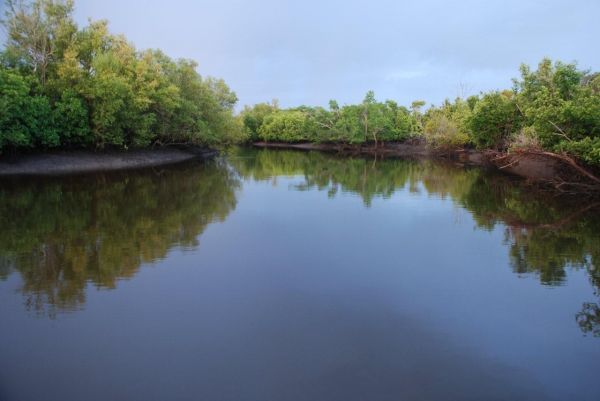
Above is a picture of a typical mangrove channel that should hold river snapper. The tide is low and the water has receded enough for the fish to have been forced out of the trees and into the channel. When the tide is receding it is a great time to cast topwater lures that can be fished directly above submerged structure, or right next to partially exposed structure, or flicked beneath overhanging trees. The lure should be fished slowly, giving the snapper plenty of time to have a good look at it and to decide to eat it. I find that if casts are accurate many smashes occur as the lure lands, so you always have to be ready. If not you should let the lure lie still for about six or seven seconds so that the ripples fade away, then give it a short twitch or two, just enough to make more ripples without moving the lure too far away from the actual target zone.
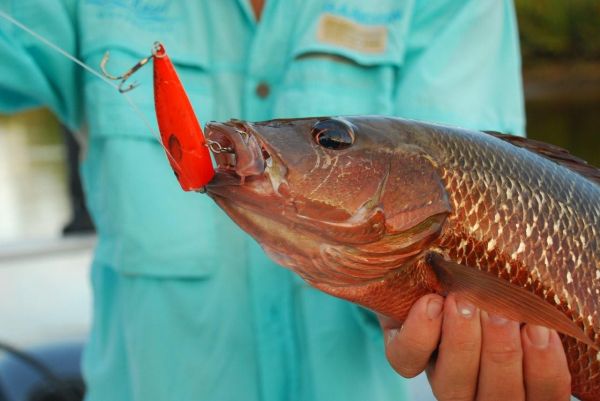
Lures such as the floating, cup faced popper above are excellent for targeting river snapper.
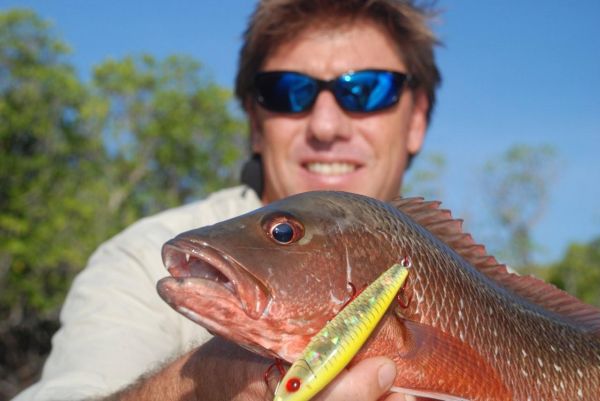
Another great river snapper lure, which can be worked slowly on the surface is the mirrOlure 7M. Unfortunately these lures are difficult to find in SA. Specialist lure shops such as Alcocks in PE sometimes have stock.
Although colour is generally not a crucial factor for surface lures I do find that any orange, red or gold lures have worked well for me in the past for this species and I tend to use those colours more than others.If you do not get a smash or even a swirl on your lure after casting it at a likely looking piece of structure do not just move on. It is always worth having a few throws at good looking spots. Sometimes there is something about the presentation of the lure on a subsequent cast that causes a strike reaction from the fish. If you get a missed strike, then have another cast immediately, often the fish comes back for another go. If not, then mark the spot and come back later, the same fish will more than likely be holding there and you can have another go at him.
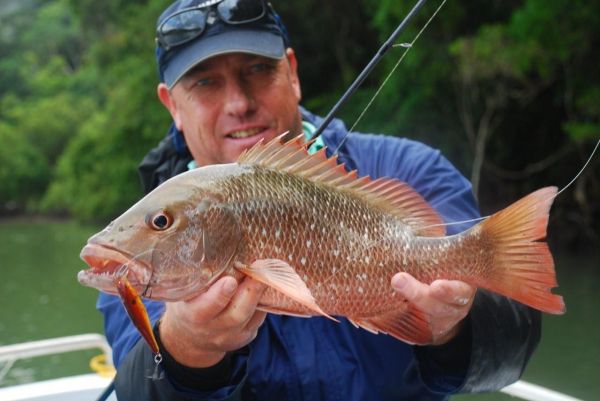
Another great option for river snapper is a floater/diver type lure. Above is a fish caught in a Transkei river on a Rapala Shallow Shad Rap, fished with a very short twitch, just enough to get the lure to dive about 15cm below the surface, then allowed to float back up and break surface again. This is repeated a number of times until the lure is about two metres away from the target structure, then it can be retrieved back to the boat with a quicker retrieve with the odd twitch thrown in.While most hits do come as the lure lands, or on the first twitch or two, there are those occasional fish that will follow the lure all the way back to the boat and hit it as you are going to lift it from the water. Apart from the Shallow Shad Rap, Rapala Original Floating lures are also good for this job.
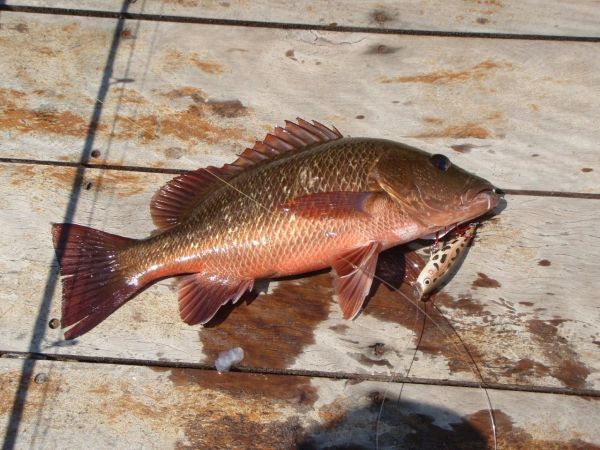
Another river snapper falls to the deadly Rapala Skitter Pop above.
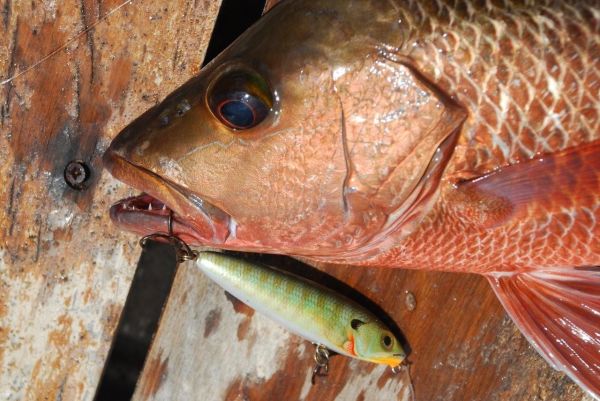
The Rapala X-Rap Walk is also a great option for a topwater lure. Its gentle zig-zagging action is irresistible to snapper and it can be done with a stop, start retrieve that allows it plenty of time in the strike zone.Fishing for river snapper this way is very much like fishing for bass. It requires a great deal of patience, perseverance and self belief. You need to constantly remind yourself to slow down, for this species the slower you fish, the better success you will have. Think as you fish, look for places to cast your lure, aim your casts deep into the structure wherever you can. I cannot over emphasise the importance of accurate casting. If you are not landing your lure right on the money, then your chances are so much less. I generally try to land the lure right against a rock or stump coming out of the water. If you are battling with accuracy then rather move in closer and make shorter, more accurate casts.
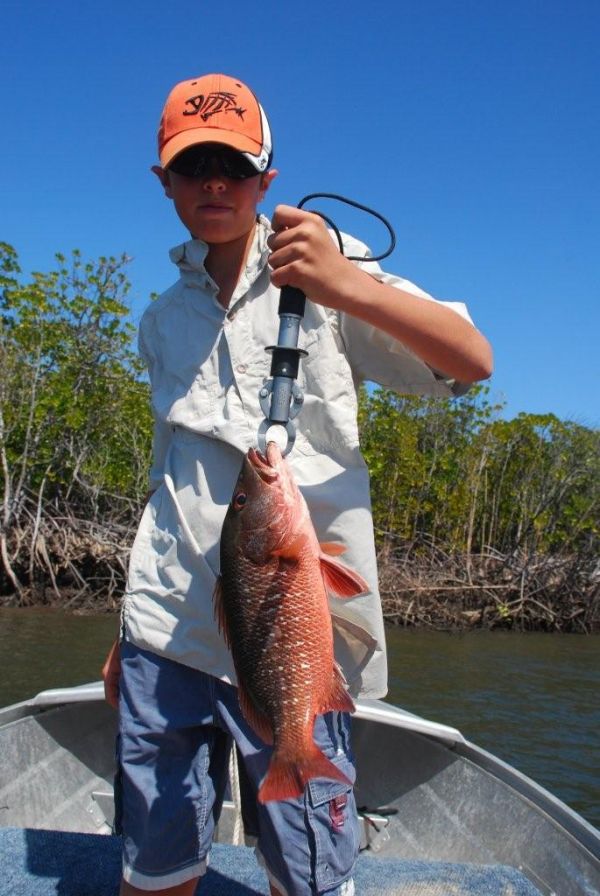
Stealth pays off. Being able to sneak in close with an electric motor or paddling quietly greatly enhances your chances. Try not to knock the boat or make any noise. Any sound will alert the fish, and a wary fish is far less likely to attack a lure than one that is blissfully ignorant of your presence. If you are quiet, you can target these fish from very close, making casts of five metres or so.
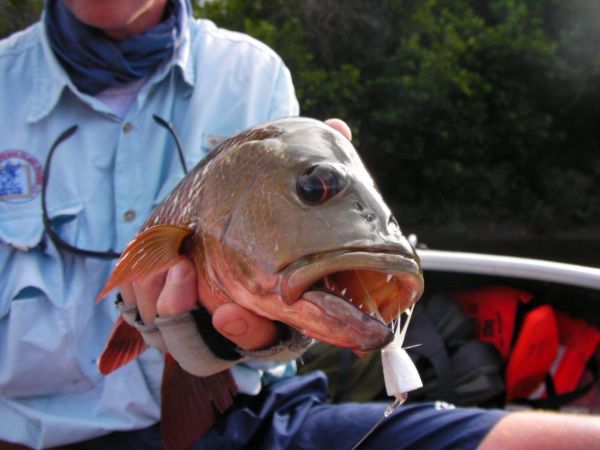
The business end of a river snapper, those teeth can hurt you, so be careful when handling these fish!
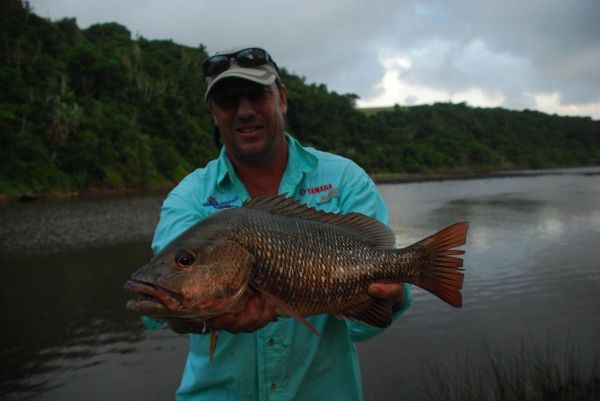
Once again, don’t be afraid to stay out late or arrive early. These fish are most active in the hours of darkness and will be more likely to take a lure during dawn and dusk. Putting in the hours means catching the fish!
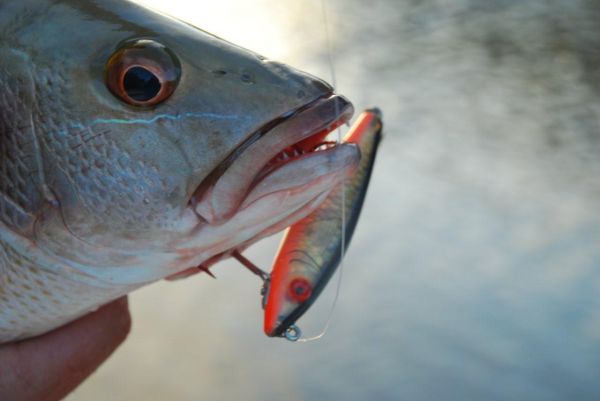
That beautiful blue line beneath the eye is diagnostic of a river snapper. Most importantly, remember that these special fish are survivors. They seem to somehow live through all sorts of hardships, such as degradation of their rivers etc. It is a real priviledge to catch one, and when we do I would urge you most strongly to enjoy looking at the fish, get some beautiful photographs, and then release it to make somebody elses day in the future. Remember, life is a careful balance and you will get out what you put in.

- Maldives Trigger - April 28, 2022
- Matoya Humpback – Figuring it out - December 15, 2021
- Mixing It Up - November 24, 2021